Interpreting AI for Data People
When people hear “AI,” they often imagine something mysterious — almost like magic. A black box that thinks and decides on its own. But the truth is much simpler:
AI isn’t magic. It’s just math, logic, and lots of data — packaged in clever ways.
If you’re a Data Pro (SQL Developer, DBA, Data Engineer, or Data Analyst) you already work with data every day.
The good news? That’s the foundation of AI.
In this post, let’s break AI into concepts you already understand, so you can see it for what it really is — and how you can work with it.
What Is AI Really Doing?
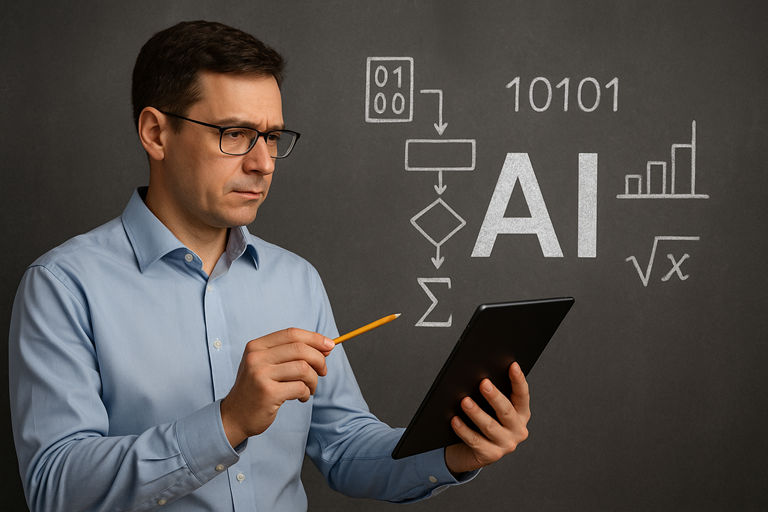
At its core, AI doesn’t actually ‘think’ like a human—at least not yet. It identifies patterns in data, applies probabilistic reasoning, and generates outputs based on probability.
How?By using:
- Math — linear algebra, statistics, probability
- Logic — rules, if-then conditions, optimization steps
- Data — massive datasets to “learn” relationships
Think of it like:
- SQL Query Optimization: The optimizer finds the “best plan” based on statistics.
- Index Recommendations: Database engine suggests indexes by analyzing patterns in query usage.
- Power BI’s Key Influencers Visual: Uses regression and decision trees to explain what drives an outcome.
Everyday AI in Action:
- Spam Filter in Email → Learns patterns in words/senders and predicts what looks like spam.
- Google Maps Traffic Prediction → Uses past traffic data + real-time signals to estimate travel time.
- Netflix / Prime Recommendations → Suggests movies by finding patterns in what you and others watched.
- Voice Assistants (Alexa, Siri, Google): Understand and respond to natural language.
- Self-Driving Cars: Detect objects, predict movement, and make driving decisions in real time.
- ChatGPT, Gemini, Grok, Claud, Llama & Copilot etc.: Generate human-like text, code, image, video etc.
- Medical Imaging AI: Identify tumours or diseases from X-rays and MRIs.
- Customer Support Chatbots: Resolve queries with conversational AI instead of scripts.
- Personalized Ads: Predict what products you’re most likely to click on.
None of these are magic. They’re algorithms, math, and data-driven decisions — the same building blocks AI uses.
How AI Relates to What You Already Know
If you’ve ever:
- Used a CASE statement in SQL
- Written a WHERE filter to segment data
- Created a KPI or trend report in Power BI
- Tuned a query using statistics
…you’ve already touched on the core principles AI relies on.
AI just:
- Scales it up (billions of rows, huge dimensions)
- Automates the math (no manual regression or probability calculations)
- Learns patterns dynamically (not just from fixed rules)
Breaking Down AI in Simple Data Terms
For most Data People, AI feels mysterious because people throw around words like neural networks, embeddings, and transformers. But here’s how to think about it in terms you already know:
1. Machine Learning (ML) — Like Advanced GROUP BY and Pattern Detection
Imagine you’re analyzing customer churn (when customers stop using your service or leave your business). Normally, you’d:
- Write a GROUP BY query to segment customers.
- Calculate churn rates manually.
- Decide thresholds for “at-risk” customers.
Machine Learning does this automatically:
- It looks at historical data (who churned, who stayed).
- It finds patterns — age, region, purchase frequency, etc.
- It predicts who might churn next, without you manually coding the logic.
Think of ML as: An automated analyst that builds “smart” GROUP BYs and CASE rules based on past data.
2. Large Language Models (LLMs) — Like Super-Powered IntelliSense
You know how IntelliSense in IDEs like SSMS or VS Code helps you autocomplete code?
LLMs like GPT work the same way — but for any text.
- You type: “Get me all policies with claims above $10,000 this year.”
- It predicts the SQL query you want, using patterns it learned from billions of examples.
It doesn’t “understand” like a human — it just guesses the most likely text (or SQL or python) based on context.
Think of LLMs as: A hyper-intelligent autocomplete system, trained on massive datasets.
3. AI Agents — Like Dynamic Stored Procedures with Decision-Making
A stored procedure can:
- Take input
- Run queries
- Return results
But an AI agent can do more:
- Read a requirement (in plain English)
- Write the SQL or Python code
- Execute the query
- Analyze the result
- Decide what to do next (alert a team, generate a report, update a dashboard)
Think of AI Agents as: A stored procedure that not only runs, but also thinks about what to do next — based on goals you set.
Why This Matters
Because once you see that AI is just structured math and data, it stops feeling like a mystery. And you realize:
- You already understand its building blocks.
- You don’t need a PhD to start using it.
- You can build AI-powered workflows using the same tools you already know (SQL, Python, Power BI, etc.).
Final Takeaway
- AI isn’t a magical black box.
It’s probabilities, rules, and data — supercharged by compute power. - And as someone who already understands data, you’re halfway there.
Coming up next…
We’ll explore the evolution of AI and how it became what it is today.
Let’s keep building “AI The One — With Uday.”
#Foundation #learn #ai #sql #dba #llm #dataengineer #dataanalyst #genai #agenticai #openai #llama











[…] “AI Isn’t Magic — It’s Just Math and Logic with Data” […]